Search for the best travel insurance in the UK and you will find a wall of providers, each claiming to offer the best deal, the most comprehensive cover, or the cheapest price. None of that tells you whether a policy is right for your trip. The best travel insurance is not a single product or a single brand. It is the policy whose cover matches your destination, your health, your plans, and the amount of money you have already committed to the trip, at a price you can afford and with terms you actually understand. This guide walks through how to choose it, step by step, without jargon and without leaning on headline prices that hide important gaps.
Start with a simple idea. Travel insurance exists to protect you against costs you could not comfortably pay yourself if something went wrong far from home. Medical treatment abroad, an emergency flight home, a cancelled holiday you have already paid for in full, or a bag that never arrives can each turn a good trip into a serious financial problem. A policy that covers those risks properly is worth far more than a policy that looks cheap but leaves the biggest risks uncovered. The sections below explain each type of cover, show how to compare policies fairly, and point out the small print that most often causes disappointment.
For a broader overview of what holiday cover includes and what it usually leaves out, our guide to holiday insurance in the UK is a useful companion to this article. It covers the basics in one place, while this guide focuses on the practical question of choosing between policies once you know what cover is available.
What “Best” Really Means for Your Trip
There is no policy that is best for everyone, because travellers are not all the same. A solo traveller heading to a European city for a long weekend has very different needs from a family taking a long-haul holiday, a backpacker travelling for months, or a cruise passenger visiting several ports. Your age, your health, your destination, the length of your trip, and the activities you plan all change what good cover looks like. A policy designed for a beach holiday may be a poor fit for a walking holiday, and a policy built for frequent business travellers may include cover a leisure traveller will never use. The right question is never which policy is best in general. It is which policy is best for this trip, for these travellers, doing these things.
It also helps to separate the price of a policy from the value of a policy. A low premium can be a sign of sensible, well-matched cover, but it can also be a sign of low limits, a high excess, or long exclusion lists. An excess is the amount you agree to pay yourself toward a claim before the insurer pays the rest, and a policy with a high excess may look affordable until you actually need to claim. Similarly, a policy with a generous overall limit may still cap individual items at a low level, which matters a great deal if you are claiming for a single valuable item. Value means cover that pays when you need it, for the things that would actually cost you money, with conditions you can meet.
The Main Types of Cover, Explained
Most travel insurance policies are built from the same building blocks, even when providers describe them in different words. Understanding each block makes comparison much easier, because you can check whether a policy includes it, how much cover it offers, and what conditions apply. The main areas are medical cover, cancellation and curtailment, baggage and belongings, travel delay and missed departure, and personal liability. Many policies also add cover for travel documents, legal expenses, and the failure of a travel provider, but the core blocks below are the ones to judge first.
Emergency medical cover is the most important part of any travel policy. It pays for hospital treatment, doctors, ambulances, and medical transport back to the UK if you become seriously ill or injured abroad. Medical costs vary enormously between countries, and private treatment or an air ambulance can be extremely expensive, so the medical limit should be high enough for your destination rather than merely present on the policy. Check whether the insurer pays hospitals directly or reimburses you after you have paid, and make sure there is a round-the-clock emergency helpline you can call from abroad. If something goes wrong, calling that helpline early can make the difference between a smooth claim and a disputed one.
Cancellation cover reimburses prepaid, non-refundable costs if you have to cancel before departure for a reason the policy covers, such as illness, injury, or a bereavement in the family. Curtailment cover works the same way for a trip cut short after it has started, covering unused prepaid costs and the cost of getting home early. The cancellation limit should cover the full prepaid cost of your trip, not just part of it, because a limit that falls short leaves you paying the difference yourself. Also check when cancellation cover starts. A policy bought on the day you book protects you from that date, while a policy bought just before departure cannot help with a cancellation that happened earlier.
Baggage and belongings cover compensates you when bags are lost, stolen, damaged, or delayed. Pay attention to the single-item limit as well as the total limit, because a policy can offer a reasonable total while capping each item at a level that would not replace a phone, a camera, or a good pair of walking boots. Delayed baggage cover usually pays for essential replacement items while you wait, rather than replacing the bag itself. Personal liability cover protects you if you accidentally injure someone else or damage their property while travelling. It is not the cover most travellers think about first, but it is one of the most valuable protections a policy can offer, because liability claims can be very large.

Medical Cover: The Detail That Matters Most
Medical cover deserves its own careful look, because it is where the biggest costs hide and where exclusions cause the most trouble. First, check the overall medical limit and whether it is adequate for your destination. Healthcare in some countries is far more expensive than in others, and a limit that would be ample for a European trip may be far too low for a long-haul destination. Second, check whether medical evacuation back to the UK is included, not just treatment where you are. If you are seriously ill abroad, getting home safely can be one of the largest costs of all, and it is not always part of basic medical cover.
Third, look at how the policy treats medical conditions you already have. Most standard policies exclude conditions that existed before you bought the policy unless you declare them and the insurer agrees to cover them. Declaring honestly is essential, because an undeclared condition can invalidate a related claim entirely, even if the rest of the policy is sound. If you have a health condition, a specialist policy or a policy with a medical screening process may suit you better than a standard policy, and our separate guide to travel cover for pre-existing conditions explains that choice in detail. Finally, check whether the policy covers private treatment, dental emergencies, and follow-up treatment after you return home, since these details vary and can matter more than they first appear to.
One more point is worth knowing before you travel. A UK Global Health Insurance Card, known as a GHIC, gives access to state-provided healthcare in the EU and some other countries on the same terms as local residents, but it is not a substitute for insurance. It does not cover private treatment, medical evacuation, cancellation, baggage, or delays, and it does not apply everywhere. Treat it as a useful extra alongside a proper policy, not as a reason to travel without one.
Gadget Cover and Baggage Cover: What to Watch
Many travellers now carry phones, tablets, cameras, and laptops worth a considerable sum, and gadget cover is often sold as an add-on or included within baggage cover. Read this part of the policy with particular care. Gadget cover may have its own limits, its own excess, and its own conditions, such as a requirement to report theft to the police within a certain time or to keep devices in your hand luggage rather than checked baggage. Valuables left unattended, or kept in checked luggage, are commonly excluded or capped at a low level, which catches many travellers out after a theft from a hotel room or a vehicle.
Before paying for extra gadget cover, check what your existing cover already includes. Your baggage section may already cover personal electronics up to a limit that suits your trip, and your home insurance may cover items away from home as well, although it will not replace the medical and cancellation protection of a travel policy. If you do buy gadget cover, list the items you actually travel with and compare the single-item limits with what it would cost to replace them. A policy that covers a phone only up to a fraction of its replacement cost is not the protection it appears to be. Keep receipts or proof of purchase where you can, and photograph valuable items before departure, since insurers may ask for evidence of ownership when you claim.
Annual Cover vs Single-Trip Cover
One of the first practical choices is between a single-trip policy and an annual multi-trip policy. A single-trip policy covers one holiday, from departure to return, and suits people who travel once or twice in a year. An annual policy covers every trip you take within a year, usually with a maximum length for each individual trip, and it often works out better for people who travel several times a year, including short breaks and weekend trips that are easy to forget to insure individually. There is no universal rule for which is better value, because it depends on how often you travel, where you go, and the level of cover you choose.
To decide, add up what single-trip cover would cost for the trips you realistically expect to take in the coming year, on comparable levels of cover, and compare that total with the annual premium. Remember to count the short trips as well as the main holiday, since a weekend city break still carries medical and baggage risks. Also check the annual policy for a maximum trip length, because a long trip may exceed it and need separate cover. Family annual policies can cover adults and children travelling together, and some also cover children travelling with one parent, which is worth checking if your family does not always travel as a single group.
Beyond these two main types, there are specialist policies for particular kinds of travel. Backpacker policies cover long trips across multiple countries over several months. Cruise cover adds protection for missed ports, cabin confinement, and itinerary changes that standard policies do not include. Winter sports cover is usually an add-on for skiing, snowboarding, and related activities. Choosing the right type of policy first, before comparing individual providers, stops you paying for cover designed for a completely different kind of trip and helps you compare like with like.

Matching Cover to Your Trip
A good way to choose cover is to work through your actual trip, step by step, and ask what could go wrong at each stage. Where are you going, and how expensive is healthcare there. How long are you away, and how much have you prepaid. Are you travelling alone, as a couple, or as a family. What will you actually do each day, and does that include anything active or adventurous. What are you taking with you, and how much would it cost to replace. Answering those questions honestly gives you a shortlist of cover you genuinely need, and it stops you paying for extras that sound reassuring but add little for your trip.
Destination and accommodation choices shape the risks you are insuring, and planning the trip properly helps you judge them. Our guide to where to stay in Malta shows how the area and hotel you choose affect a short-haul holiday, from the activities nearby to the way you get around, and each of those details changes what cover matters most. A short city break has a different risk profile from a long-haul holiday too. Our guide to a romantic weekend in Amsterdam is a reminder that even a brief trip benefits from medical and cancellation cover, because illness or a disrupted flight can affect a two-night break just as surely as a two-week holiday.
Activities deserve the same careful thought. Standard cover usually includes sightseeing, swimming, and gentle leisure activities, but more adventurous pursuits may be excluded, limited, or covered only under specific conditions. If your trip includes hiking, watersports, cycling, or anything at altitude, check whether each activity is named on the policy and whether there are limits on height, difficulty, or the need to use a licensed operator. Rescue and evacuation are separate from treatment, and mountain rescue or helicopter evacuation can be extremely costly, so confirm they are included rather than assuming they are. Our guide to the best hikes in Acadia National Park illustrates the kind of serious walking holiday where activity cover, rescue cover, and baggage cover for outdoor gear all need checking before departure.
How to Compare Policies Like for Like
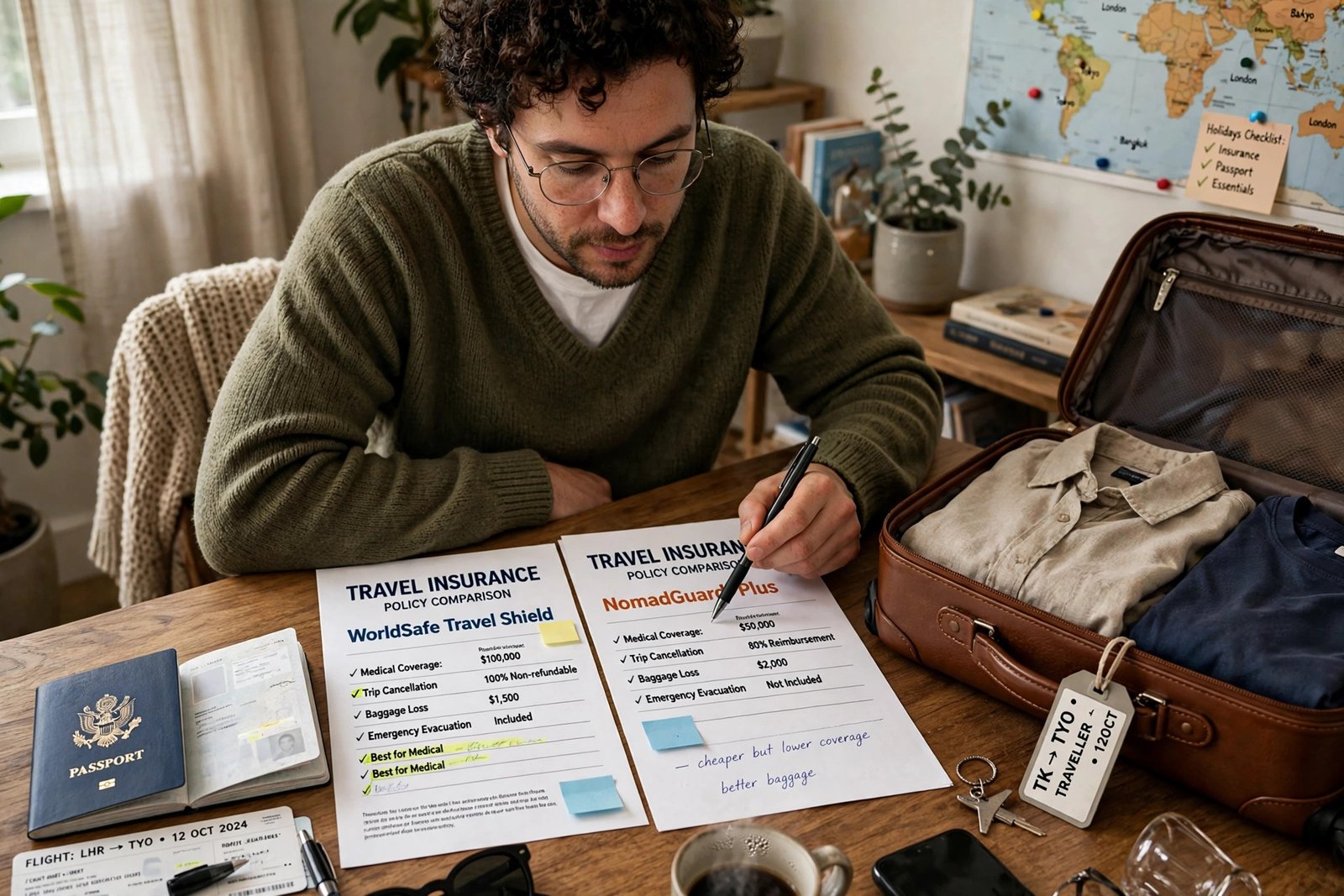
Comparing policies on premium alone is the classic mistake, because two policies at very different prices may offer very different protection. A fair comparison lines policies up on the same measures, so that differences in cover become visible rather than hidden behind a headline figure. Work through the checklist below for each policy you are considering, and keep notes as you go, since policy documents are long and it is easy to forget which policy offered what by the time you have read several of them.
- Medical cover limit: high enough for your destination, with medical evacuation back to the UK included.
- Cancellation limit: enough to cover the full prepaid cost of your trip, starting from the date you buy the policy.
- Excess: per person, per claim, or per section, and at a level you could actually afford to pay if you claimed.
- Baggage limits and single-item limits: a generous total means little if each item is capped at a low level.
- Gadget cover: whether electronics are included, what the limits are, and what conditions apply to theft claims.
- Activity cover: everything you plan to do, named and included, with rescue and evacuation where relevant.
- Medical conditions: declared and accepted in writing, not merely mentioned in conversation.
- Claims process: a round-the-clock emergency helpline, and whether the insurer pays hospitals directly or reimburses you afterwards.
- Exclusions: read in full, especially for destinations, activities, and circumstances relevant to your trip.
When you compare, use the policy wording rather than the marketing summary. Summaries are written to sell, and they highlight strengths while leaving gaps to the full document. The policy wording is the document that decides a claim, so it is the document that should decide your purchase. If a point is unclear, contact the insurer before buying and ask for the answer in writing. A clear written answer protects you later in a way that a sales conversation does not, and an insurer that cannot answer a straightforward question clearly is telling you something useful about how a claim might be handled.

Reading the Exclusions Before You Buy
Exclusions cause more disappointment than any other part of a travel policy, and they are worth ten minutes of careful reading before you commit. The most common exclusions include medical conditions that were not declared, activities that are not listed on the policy, travel to destinations where official advice warns against travel, incidents connected with excessive alcohol or drug use, and belongings left unattended or kept in checked luggage. None of these is unreasonable in itself, but each can turn a claim you expected to succeed into a refusal, and the time to discover a gap is before departure, not at a foreign hospital desk.
Pay particular attention to the parts of the exclusions that relate to your own trip. If you are travelling with a health condition, read the medical exclusions closely. If your trip includes anything active, read the activity exclusions and the activity list together, since an activity can be excluded by omission as well as by name. If you are travelling to a region where official travel advice changes from time to time, check how the policy treats advice that changes after you book, and what happens if you travel against advice that was already in place. If anything is ambiguous, ask the insurer and keep the reply. Ten minutes spent here can save a great deal of frustration later.
When to Buy and What to Do If Something Goes Wrong
Buy your policy as soon as you book your trip, not in the days before you fly. Cancellation cover only protects you from the date the policy starts, so a policy bought late cannot help with a cancellation that became necessary earlier. Buying early also means medical screening and any questions about your health are settled well before departure, when there is still time to choose a different policy if the terms do not suit you. Keep the policy number and the emergency helpline in your phone and in a paper copy, and tell someone at home where they are, so help can be arranged even if you are unable to make the call yourself.
If something goes wrong abroad, call the emergency helpline before arranging expensive treatment or transport yourself, unless it is a genuine emergency where delay would be dangerous. Insurers can refuse costs they were not given the chance to approve, and the helpline can often arrange direct payment to a hospital, which spares you a large bill. Keep every receipt, medical report, and police report, and report thefts to local police promptly, since insurers usually require a police report for stolen belongings. If a claim is refused, ask for the refusal in writing and check it against your policy wording, since genuine misunderstandings do happen, and a polite, evidence-backed challenge sometimes succeeds.
Frequently Asked Questions
Is the cheapest travel insurance a bad choice?
Not necessarily, but cheap is not the same as good value. A low-priced policy can be excellent if its medical limit, cancellation limit, excess, and exclusions all suit your trip. It is a poor choice if the low price comes from low limits, a high excess, or exclusions that remove the cover you actually need. Compare the detail, not just the premium, and judge cheap against what the policy would pay in a realistic claim.
Do I need travel insurance for a trip within the UK?
Medical cover is less of a concern for a UK trip, since you have access to NHS care, but cancellation, baggage, and travel disruption cover can still be valuable, especially if you have prepaid accommodation or transport that cannot be refunded. Some annual policies include UK trips, so check whether your existing cover already protects a domestic break before buying a separate policy.
Should I choose annual or single-trip cover?
It depends on how often you travel. Compare the total cost of single-trip policies for the trips you realistically expect to take in a year, on the same levels of cover, with the annual premium. If you travel several times a year, including short breaks, annual cover often works out better and removes the risk of forgetting to insure a trip. Check the maximum trip length on an annual policy before relying on it for a long journey.
Does travel insurance cover gadgets like phones and cameras?
Sometimes, but not always to the level you might expect. Gadgets may be covered under baggage cover, offered as a separate add-on, or subject to their own limits and conditions. Check the single-item limit, the conditions for theft claims, and whether valuables must be kept in hand luggage. If the limits are low, a dedicated gadget policy or cover under your home insurance may be worth considering alongside your travel policy.
What if my travel plans change after I buy a policy?
Tell your insurer. A change of destination, trip length, or planned activities can affect whether you are covered, and an undisclosed change can cause problems if you later claim. Most insurers can adjust a policy, sometimes with revised terms, and it is far better to sort this out before departure than to discover the issue during a claim.
Conclusion
Choosing the best travel insurance in the UK is less about finding a winning brand and more about matching a policy to your trip. Check the medical limit for your destination, make sure cancellation cover matches what you have prepaid, confirm that your activities and any health conditions are properly covered, and read the exclusions before you buy. Compare policies on the same measures, keep the emergency number where you can reach it, and buy the day you book. A policy chosen this way may not be the cheapest you saw, but it is the one most likely to pay without a fight when you actually need it, and that is what best really means.